Wednesday, November 19, 2014

Tokay Tokay Tokay!


I have always loved geckos. I think they are adorable and amazing pets. When I was looking at pictures of geckos, one gecko stuck out to me. I thought this little guy was the cutest, funniest, and most interesting of them all. Tokay geckos are actually a tad famous. They are very friendly, which makes them an ideal pet. Also, their vibrant colors of blue with orange polka-dots really catch the eye. Male and female Tokay geckos differ in this sense as, like many animals, the males are more brightly colored, while females have more deluded colors. The males also have a more swollen tails due to the existence of hemipenes (two penises). Their skin is velvety to the touch regardless of their appealingly bumpy skin. They can get to be rather large, about 14 inches from head to tail, and are the largest gecko known to man. Their limbs and body are very well defined and developed. Their feet have fine setae on them, which allows them to overhanging surfaces and move at fast speeds. A few of their defense mechanisms include changing colors, having folds of skin that prevent it from casting a shadow, and the ability to unhitch their tails from their bodies. After shedding its tail, the Tokay gecko will regenerate a new one 3 weeks post tail shed.
Natural Location of Tokay Gecko
Tokay geckos prefer a tropical rainforest habitat. They live in the trees and on cliffs from northeast India to the Indo-Australian Archipelago, but can usually be found in our very own homes. Like I said before, they are wonderful pets. They are noisier than most geckos, however. These noises are often mating calls or defense screams. Otherwise, they are very docile creatures. They are insectivores, so their typical household diet is mealworms, cockroaches (in adulthood), crickets, grasshoppers, and locusts.  Because of taste for pests, they are seen as good luck in southeast Asia.
If you wish to purchase them online, they range from $20 to $100. This can be dependent on their color, age, gender, or how slimy the sales person is. Luckily, they are not endangered, so they are easy to come by, thus the low price. I will post some links to sellers of Tokays, but I always suggest that you purchase from a local breeder. You could also attend a Reptile Expo. I happen to know that they have one in Chicago, but they are the best place to buy reptiles. They know what they're doing. For more information to look at local breeders, look at my blog, Reptile Care.

Tokay gecko hatchling
Scientific Name: Gekko Gecko

Links: http://nationalzoo.si.edu/Animals/ReptilesAmphibians/Facts/FactSheets/Tokaygecko.cfm
http://www.backwaterreptiles.com/geckos/tokay-gecko-for-sale.html
http://www.reptilesmagazine.com/Reptile-Events-Calendar/

Monday, November 17, 2014

Praise The Snakes!

Snakes are very symbolic in many different cultures and religions. Here are a few that may come to mind.
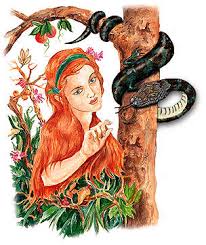
Eve and the Serpent
Christianity
Possibly the most well known religious story involving snakes would be that of Adam and Eve in the garden of Eden. In this story, the serpent (symbolizing Satan) entices Eve to eat the forbidden fruit of God. In Christianity, because of this story, the snake is viewed in a negative way as a symbol of evil. The snake appears many times after, including when Moses faces the Pharaoh in Egypt to prove the power of God. I suppose this is a more positive view of the snake. Many Christians still believe, however, that snakes are a symbol of evil and sin.
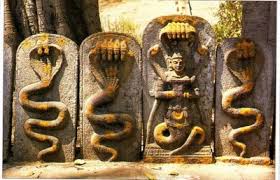
Hindu Statues depicting Snakes
Hinduism
In ancient Hindu religion, the serpent, Naga, acts as the nature spirit that protects water sources. It is the symbol of fertility and brings forth the rain needed to survive. This is the positive view of the snake. However, because Naga controls the waters, it can also bring fourth flooding and drought. This is the negative view. Naga's actions are meant to reflect how humanity is treating the sacred snakes. The snake is also the symbol of infinity. As stated by Lord Krishna, "among the serpents I am Ananta". Ananta represents the infinite primal energy. Snakes also represent desire. Just as a person who is bitten by a snake suffers and dies, one who is bitten by desire also suffer when going through rebirth. Sexual energy in the chakras is also depicted as a coiled snake for similar reasons. Because of the large amount of poisonous snakes in India, the snake is a symbol of death. I don't truly feel the need to explain why.

Jormungandr and Thor
Norse
In ancient Norse religion, Jormungandr (Great beast), the offspring of the mischievous god, Loki, was a great serpent destined to die by Thor's hand at the battle of Ragnarok. Odin, the king of the Norse gods, sought to delay this prophecy. In doing so, Odin tossed Jormungandr into the ocean, where it grew so large that it encircled the entire earth. From what I can find, it serves no purpose other than bringing forth the apocalypse (battle of Ragnarok).

artist's vision of Renenutet
Egyptian
There is actually a goddess in Egyptian Mythology that is the protector of the snakes: Renenutet. Her tasks changed throughout mythology. She is often depicted with having a female body with the head of a raised cobra. The ancient Egyptians decided to depict her as a deadly snake because they saw cobras in a different way than modern day society. They acknowledged the power of the cobra, and recognized their usefulness -eating rats, birds, and other vermin that harm their crops. That is why, she was also the guardian of the crops of the farmers. She also acted as the personal body guard of the king on earth and in the afterlife, spitting fire at his enemies. During the rise of Christianity, she also became a symbol in the house, protecting the children. Supposedly, she named them and nourished them through the mother. A festival was held in her honor at the end of winter/spring when crops were planted as well as the beginning of summer, when the crops begin to ripen.

Snakes are a key part in many religions, mainly because they are EVERYWHERE. Though I was not able to name every religion known to man, I tried to cover the religions that would seem most familiar and talk about the snake frequently.

Let's not forget greek mythology
Links: http://norse-mythology.org/gods-and-creatures/giants/jormungand/ 
http://www.2012-spiritual-growth-prophecies.com/serpent.html
http://www.egyptianmyths.net/renenutet.htm http://www.hinduwebsite.com/buzz/symbolism-of-snakes-in-hinduism.asp

The King

Scale size
I am talking about the icon of the snake world. The overused slitherer that you've seen in every action movie involving a villain: the King Cobra. It is truly the king, not only due to its venom, but also its sheer size. The King Cobra reaches 18 feet in adulthood and can straighten one-third of its body and stare a full grown man straight in the eyes. Though they are not the most venomous -that title is held by the Fierce Snake- it is the largest venomous snake known to man. Though they are not the most venomous, they are a force to be reckoned with. With a single bite (about 7 milliliters of fluid) , their neurotoxin can kill up to 20 men or a single elephant. They are more likely to leave humans alone, but are very aggressive when threatened. I suppose you would be too if your life is possibly in danger.
Skeleton
Their habitats are usually rainforests and plains where they can be found in trees, on the ground, or near a source of water. I suppose I learned something new because I thought they lived in desert regions, but those are rattlesnakes. They like in southeastern Asia where they prey on other snakes, small mammals, eggs, and lizards. A fun fact is that they actually lay their eggs in nests which they guard with their lives until they hatch. This is not a common characteristic in snakes. We actually have to separate our snakes from their babies to keep them from eating the newborns. These snakes are also found as religious symbols in many tribes and are the choice snakes of snake charmers. They do not really have the same kind of hearing we do. Instead, they sense large amounts of vibration. So, they do not care about the music from a snake charmer's flute. They are purely intrigued by the shape and movement.


Scientific name: Ophiophagus hannah

Links: http://animals.nationalgeographic.com/animals/reptiles/king-cobra/
http://www.arkive.org/king-cobra/ophiophagus-hannah/

Warm Blooded Dinos- Mosasaurus


When I was looking up reptile facts, I noticed that I kept seeing this statement: most reptiles are warm blooded. I got to thinking, what reptiles don't apply to this statement, if only most reptiles are warm blooded. Turns out, there are no modern day reptiles that are 'warm blooded' per say. However, if you're willing to look back 65 to 250 million years ago. The time is the Mesozoic era. This was a major time in the earths existence due to the major change in vegetation. During the Triassic period (251-199.6 million years ago), the vegetation mainly consists of ferns and very unusual fauna. Moving into the Cretaceous period (145.5-65.5 million years ago), the vegetation had highly diversified. The three reptiles over this time frame that were indeed warm blooded were not land creatures, however. Their names were Ichthyosaurs, Plesiosaurs, and Mosasaurs. This blog focuses on the Mosasaurs, though blogs based on the others have been written.


Mosasaurs:
The Mosasaurs is a very odd looking creature, like the other two warm blooded dinos. It looks just like a killer whale with an elongated tail and a velociraptor's head. It reached a length of 15 meters in adulthood (98.4 feet). A fractured  head fossil had been discovered in 1764 and declared a fish, then an ancient sperm whale in 1786, then a reptile in 1808 when it was given its name, but did not receive a specific species until 1829. Mosasaurs have a very heavy build which suggests that it's prey was most likely larger and slower which is also confirmed by their poor amount of stereoscopic vision. This means that it did not rely on speed or distance as is could not properly gauge either. It most likely waited until its prey went to the surface for air, revealing itself in the illuminated water, where the Mosasaurs would quickly launch itself with its tail and kill or wound its prey. Fossils of these giants have been found in Western Europe and North America.


Links: http://www.prehistoric-wildlife.com/species/m/mosasaurus.html

Warm Blooded Dinos- Plesiosaurs

Plesiosaurs with prey
When I was looking up reptile facts, I noticed that I kept seeing this statement: most reptiles are warm blooded. I got to thinking, what reptiles don't apply to this statement, if only most reptiles are warm blooded. Turns out, there are no modern day reptiles that are 'warm blooded' per say. However, if you're willing to look back 65 to 250 million years ago. The time is the Mesozoic era. This was a major time in the earths existence due to the major change in vegetation. During the Triassic period (251-199.6 million years ago), the vegetation mainly consists of ferns and very unusual fauna. Moving into the Cretaceous period (145.5-65.5 million years ago), the vegetation had highly diversified. The three reptiles over this time frame that were indeed warm blooded were not land creatures, however. Their names were Ichthyosaurs, Plesiosaurs, and Mosasaurs. This blog focuses on the Plesiosaurs, though blogs based on the others have been written.
chilling on the beach
Plesiosaurs
The Plesiosaurs is truly the scariest I've ever seen sprout from hell's ocean. This thing looks like a whale, mixed with a giraffe, mixed with a crocodile/viper combo. These spawns of Satan existed 220 million to 65 million years ago and where some of the first fossils documented in science in 1821. This creature could be the source of the myth of the Loch Ness Monster. Essentially, it matches the description: a long neck, a broad body, a sharp toothed, strong jaw, and giant flippers. It is easy to imagine a person wondering around Loch Ness and stumbling upon a giant skeleton. The only logical solution would be that it came from the water due to its flippers, so it must be from the lake. The smallest Plesiosaurs adult skeleton that was found was 2 meters (6.5 feet) while the largest was 20 meters long (65.6 feet). They are the largest predators of all time and their skeletons can be found on every continent! From their fossils we can assume that they consumed belemnites (giant squid-like creatures) and ammonites (giant snail-squid-like creatures). Their sharp teeth vary in shape which means that they were well adapted to a wide range of prey which varies from soft sediment to armored fish. There is no evidence on how they breaded, but the Plesiosaurs was adapted like a dolphin -meaning they can breath above water- and smaller Plesiosaurs could have crawled on land and laid eggs like a turtle. This theory would explain the lack of evidence as sandy beaches are not ideal for fossilization. THEY DIED A LONG TIME AGO. So there is no monster of Loch Ness..... that we know of.
I'm so dead right now
"Loch Ness Monster"

Links: http://www.calacademy.org/explore-science/warm-blooded-reptiles
http://plesiosaur.com/more.php

Warm Blooded Dinos- Ichthyosaurs


When I was looking up reptile facts, I noticed that I kept seeing this statement: most reptiles are warm blooded. I got to thinking, what reptiles don't apply to this statement, if only most reptiles are warm blooded. Turns out, there are no modern day reptiles that are 'warm blooded' per say. However, if you're willing to look back 65 to 250 million years ago. The time is the Mesozoic era. This was a major time in the earths existence due to the major change in vegetation. During the Triassic period (251-199.6 million years ago), the vegetation mainly consists of ferns and very unusual fauna. Moving into the Cretaceous period (145.5-65.5 million years ago), the vegetation had highly diversified. The three reptiles over this time frame that were indeed warm blooded were not land creatures, however. Their names were Ichthyosaurs, Plesiosaurs, and Mosasaurs. This blog focuses on the Ichthyosaurs.

Ichthyosaurs
Though Ichthyosaurs may look like a fish, it is very much a reptile. You may notice a their reptilian features by looking at their jaw and fins. Looking at the skeleton of the creature, you will notice three strange features. The first are skeletons in their fins. They look very similar to a corn cob. This strange fin went through major evolutionary changes over the years. As time progressed, the arm bone as well as 'fingers' became more developed. These fins were mainly used for propulsion. The second thing that is notable is their giant eye socket. They are the largest ever recorded in fact. The Ichthyosaurs had very flat eyes. It is believed that the main purpose of the doughnut shaped bone kept their eyes in shape. It can also be determined that their nocturnal sight ranged from human sight or better. Finally, their vertebrae were very different from most reptiles, not because of the shape, but because of the amount. It is believed that they started out as lizards with the average amount of vertebrae, then evolved into ocean dwelling creatures. During this change, the amount and size of vertebrae also changed. The largest Ichthyosaurs documented reached a length of 15 m. Though, the smallest documented did not reach 17 cm. It is estimated that they weighed about 1230-1200 kg. Through the research of fossils found in the stomach of a Ichthyosaurs, it has been assumed that they thrived off of the ancient kin of squids with occasional other vertebrates. They lived in the area of Canada, China, Japan, Spitsbergen, and Thailand. They are extinct (obviously).


Links: http://www.ucmp.berkeley.edu/mesozoic/mesozoic.php
http://www.ucmp.berkeley.edu/people/motani/ichthyo/forefin.html