Wednesday, October 29, 2014

I'm Deadly And I Know It

Head of Fierce Snake
Color variation of Fierce Snake
The most venomous snake in the world. What a title. The Fierce Snake or Inland Taipan (Oxyuranus Microlepidotus) has been named the most venomous snake alive today. It calls Australia its home -because all things deadly love Australia- where it Queensland and the Northern Territory collide. This snake can change colors like a mood ring. In the harsh summer, it is a light straw color. In the winter, its color darkens to a very deep brown. Its head will even turn to a glossy, charcoal black which matches beautifully with the black soil it is ever so partial to. It can reach a total of 2.5 meters, but it doesn't usually get any larger than 1.8 meters in adulthood. Due to the lack of coverage in their region, they rely heavily in the cracks of the earth where they can hide from predators as well as the searing heat. Though, this snake is a force to be reckoned with. Their strikes are fast, and accurate. The toxicity of this snake is unequaled. Their prey, mainly consisting of small mammals like rodents, doesn't stand a chance. Though, their population is heavily dependent on their prey; low rodent population= low snake population. A female can lay a clutch of 12 to 20 eggs depending on the year. To my surprise, this snake has not killed any person on record. Every known bite has been properly treated and cared for. They are not currently endangered and do not have any strange morphs.

Links: http://www.reptilepark.com.au/animalprofile.asp?id=112

Common Questions

Whenever I give a presentation, I seem to always be asked the same general questions. I thought that if more than one person is interested in these answers, then I should address them in my blog.


Q: Does that snake bite?
A: This is the question I am always asked and it is one of my least favorite ones. It seems trivial to know that all animals bite. I cute bunny rabbit will bite if it feels the need. Heck, even I would bite someone if they were sticking their finger in my face. I assume that they mean to ask "Does that snake bite often?". Even then, there is still a possibility that it will bite you. If someone is holding it, it is probably safe. If it is in a box with a lid, then it is probably aggressive. Just don't be an idiot around the snake and treat it with respect, that should keep you fairly safe.

Q: Do snakes have ears/ can snakes hear?
A: Snakes don't have the same kind of ears that we like to think of; they are not visible like ours. However, they aren't deaf so to speak. They can sense vibrations and low frequency sounds due to vestiges of the apparatus in their heads. In other words, they have an inner ear that connects to their jaw that allows them to feel large amounts of vibration. What's the purpose of hissing then? It is just intended to warn predators. It is utterly useless for communication.

Q: What is the study of snakes called?
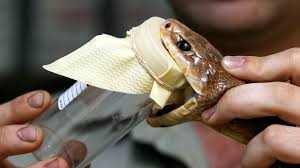
Milking a snake
A: Well, the study of reptiles and amphibians is called herpetology. Careers in herpetology can range from milking a snake to studying its venom to see if it has medical benefits.

Q: How do you milk a snake?
A: Firstly, snakes don't have utters. The 'milk' of the snake actually refers to the collecting of snake venom. Places that milk snakes often catch poisonous snakes in the wild and 'activate' the glands of venom of the snake behind the fangs. They catch the venom in cups and send it to researchers to do further investigation.

Q: Do all snakes lay eggs?
A: No. Only 70% of snakes lay eggs. Oviparous snakes -snakes that lay eggs- usually live in warm climates, while viviparous snakes -snakes with live young- live in cooler climates because their young couldn't survive the cold on their own. Boas are viviparous snakes that have live young.

I hope this helps with any questions you may have. Feel free to ask any further questions and I will happily answer.

Links: http://m.livescience.com/32252-do-snakes-have-ears.html
http://news.nationalgeographic.com/news/2003/01/photogalleries/snakes/photo5.html

Rarest Snake in the World!

Saint Lucia Racer Adult
It is always a shame when an animal is on the brink of extinction. I feel that it is important to jump at the chance to talk about these creatures to raise awareness towards them while they are still on this earth. On my quest, I found the rarest snake of all time (on the Internet of course). The lucky snake -is you want to call it that- is the Saint Lucia Racer snake. Their scientific name is Liophis Ornatus. These snakes were actually declared to be extinct in 1936, but were later rediscovered in 1973. There are only 18 known specimens surviving today. They have managed to stay alive by staying at 30 acre area of land that has remained mongoose free off the coast of Saint Lucia which is a rather dry and desert like terrain.
Saint Lucia Racer Hatchling
They survive off of the diet of lizard eggs and amphibians. They don't have very many means of protecting themselves. They are rather small, reaching a maximum size of one meter, and are nonvenomous. They mainly depend on their camouflage. They are most easily identified by their short tail and a dark brown stripe that travels from the length of their head to their tail. Their short snout may also have a decoration of yellow spots against their brown or olive green skin (when molting) that matches their yellowish-white underbelly. To keep these little snakes alive, conservationists have been working hard to maintain the natural habitat of the St. Lucia Racer while maintaining awareness about the struggle. I encourage you to look at any of the links below to become better informed on the situation.

Links: http://listverse.com/2014/09/14/top-10-rarest-snakes-in-the-world/
         http://www.fauna-flora.org/news/the-saint-lucia-racer-takes-the-title-of-world%E2%80%99s-rarest-snake/
         http://www.arkive.org/saint-lucia-racer/liophis-ornatus/

IT'S A DRAGON!!! and it's thorny

Adult Thorny Dragon
I don't know how you can look at a Thorny Dragon, and not want to learn more about it. I mean, these are the coolest things I've ever seen! The Thorny Dragon, also known as the Thorny Devil, goes by the scientific name of, Moloch Horridus. It is most recognizable with its spiky skin and beautiful camouflage as well as its curious lump on the back of its head. They can actually change their color according to their surrounding. If they happen to be in a region with red sand, their skin will change to a reddish brown. The same idea goes with yellow and black sand. Whatever color they are traveling over, that is the color of their skin. Regardless of their appearance, they are completely harmless. It does defend itself, but in a very strange manor. They use their odd bump on the back of their neck to imitate a head, while it hides its real head between its legs to protect themselves. It can also use its long thorny tail if a predator tries to flip them on their back. They use that tail for balance and to keep themselves right-side-up. Finally, like a lot of animal, they can puff themselves up to look larger.
Thorny Dragon Hatchling
They are practically the lizard-anteaters of Australia. In one sitting, they can eat 600-3000 ants! While they can only eat one ant at a time, they can whip that sticky tongue of theirs out 45 times per minute. Unfortunately, it is more prey than predator. They are very slow moving and small, so they are the best prey. Their worst enemy is the bustards, which are like a scientific experiment of chicken and goose mixed with a hawk. These winged beasts from hell are one of the main reasons why the Thorny Dragon is endangered. To keep their three to ten eggs safe, the Thorny Dragon will dig a hole underground between September and January where they take three to four months to hatch. It takes three years for them to reach maturity, and they can live up to 20 years. They reach a grand total of 20 centimeters in length.
These creatures really are amazing. It is hilarious to watch them walk. I encourage you check out my youtube link if you want a brief chuckle at the end of the day. It's a shame that they are endangered. Luckily, people are taking action by putting cages around their eggs to protect them.


Links: http://a-z-animals.com/animals/thorny-devil/
http://www.wired.com/2014/09/the-creature-feature-10-fun-facts-about-the-thorny-devil/
https://www.youtube.com/watch?v=sxawWKuA4JM

Sunday, October 12, 2014

Chubby, Spotted Lizard

Leopard Gecko
The other day, I was admiring a few adorable lizards in my reptile club. They had chubby tails that took up 50% of their overall body size and these gorgeous black spots that seemed to fight through their light yellow skin. Curious, I asked what these funny-looking lizards were called. They are the very friendly, Leopard Geckos. Their scientific name is Eublepharis Macularius. These geckos also belong to a special family called the Eublepharinae, which translates to eye-lidded geckos. Most geckos don't have eyelids, but the leopard gecko has movable ones that allow them to close their eyes when they sleep. They don't, however, have the padded feet that most geckos have that allow them to climb vertically. They make up for it with their long claws that stem from their fingers. Looking at these geckos, there is no wonder where they got their name. As I said, they have dark black leopard-like spots that contrast against their yellow based skin, though they can also have lavender skin.

They do come in a wide rang of morphs such as albino, pattern-less, bold stripes, and hybinos. Hatchlings are usually born with dark bands, which eventually lighten up in adulthood. Like most lizards, the leopard gecko can loose its tail when threatened due to a cracked vertebrae as well as a special arrangement of muscle that can release cleanly and quickly. Though, that chubby tail is vital. It works almost like a camel's hump and can store fat for periods with little to no food. Why are leopard geckos such ideal pets? Well, they have an unusually kind disposition. It takes a lot to provoke a leopard gecko to bite. They also aren't very vocal (I didn't even know that was a problem among geckos). They can reach up to ten inches, but the ones we have are about five inches. They can also live up to 20 years in captivity if properly cared for. Their natural habitat is in the middle east where they can be found in the rocky desert or sparse grass lands. Because of the intense temperatures of this region, they are nocturnal animals. In the night, they hunt for other lizards, insects, and spiders. They are also immune to the sting of a scorpion, so they make sufficient food as well. As far as pricing goes, they can range from $20-$70 depending on the breeder. Though, I would encourage you to look at my Reptile Care blog if you're planning on buying from a store. I'm only throwing this fact in because it is just so weird, but leopard geckos don't have liquid urine. Instead, they excrete nitrogenous waste in crystal form. So if you weren't already think these geckos were interesting, how about that?
very happy Leopard Gecko
Leopard Gecko Hatchling

Links: http://www.paulsagereptiles.com/leopardgenetics.htm
        http://nationalzoo.si.edu/Animals/ReptilesAmphibians/Facts/FactSheets/Leopardgecko.cfm